
UV Disinfection Technologies
Ultraviolet (UV) disinfection is a proven, chemical-free technology used to inactivate bacteria, viruses, fungi, and other harmful microorganisms. Modern UV disinfection devices are based on two primary light sources: low-pressure mercury UV lamps and UV light-emitting diodes (UV LEDs). Each technology has distinct advantages and is suited to different applications.
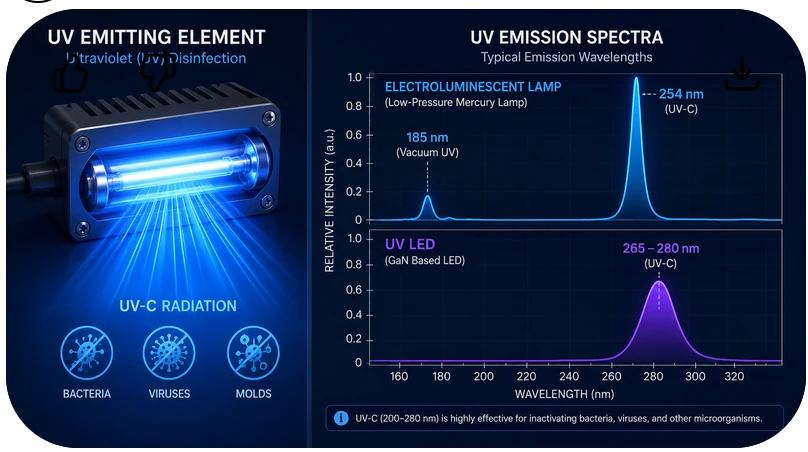
Mercury UV Lamps
Low-pressure mercury lamps remain the preferred choice for high-power UV disinfection systems. They generate ultraviolet radiation through an electrical discharge inside a sealed quartz tube containing a small amount of mercury vapor. The lamp operates with an electronic ballast that regulates the current and ensures stable, reliable performance.
Mercury UV lamps emit two principal wavelengths:
254 nm (UV-C) – Highly effective at destroying bacteria, viruses, molds, and other microorganisms by damaging their DNA and RNA, preventing reproduction.
185 nm (Vacuum UV) – Produces ozone (O₃), one of the most powerful oxidizing agents used for disinfection.
The combination of UV-C radiation and ozone provides enhanced sensitization. While UV light disinfects surfaces and air that are directly exposed to the radiation, ozone diffuses throughout the treated space, reaching shaded areas, crevices, and other locations that direct UV light cannot illuminate. This dual-action process significantly improves overall disinfection efficiency.
Advantages
High optical output and disinfection power
Ideal for treating large spaces and high air volumes
Simultaneous UV-C and ozone generation (when 185 nm emission is present)
Proven technology with decades of successful use
UV LED Technology
UV light-emitting diodes represent the latest generation of ultraviolet disinfection sources. Manufactured using advanced semiconductor materials such as gallium nitride (GaN) and aluminum gallium nitride (AlGaN), UV LEDs are compact, robust, and energy-efficient.
Most germicidal UV LEDs emit in the 265–280 nm wavelength range, which closely matches the peak absorption of microbial DNA. This wavelength range provides excellent disinfection performance while requiring only a low-voltage power supply, typically 6–7 V DC.
Unlike mercury lamps, UV LEDs contain no mercury, reach full output instantly, and can be switched on and off repeatedly without reducing their service life. Their compact size makes them ideal for portable devices, battery-powered equipment, and applications where space is limited.
Key Benefits
Compact and lightweight
Low-voltage operation (typically 6–7 V DC)
Instant start with no warm-up time
Long service life
Mercury-free and environmentally friendly
Suitable for portable and battery-operated products
Choosing the Right Technology
The choice between mercury UV lamps and UV LEDs depends on the intended application.
Mercury UV lamps provide the highest ultraviolet output and are the preferred solution for large-scale air and surface disinfection, industrial systems, and applications requiring ozone-assisted sterilization.
UV LEDs are ideal for compact, portable, and low-power devices intended to disinfect personal items, medical instruments, electronics, drinking water, and confined spaces. Their durability, energy efficiency, and maintenance-free operation make them increasingly popular in modern consumer and professional products.
Both technologies are capable of providing highly effective UV disinfection when properly designed and operated. Selecting the appropriate UV source ensures the best balance of performance, portability, power consumption, and cost for each specific application.